Review


primary human lung microvascular endothelial cells (hmvec-l)  (Lonza)


Bioz Manufacturer Symbol Lonza manufactures this product  
  • Logo
  • About
  • News
  • Press Release
  • Team
  • Advisors
  • Partners
  • Contact
  • Bioz Stars
  • Bioz vStars
  • 90

    Structured Review

    Lonza primary human lung microvascular endothelial cells (hmvec-l)
    Primary Human Lung Microvascular Endothelial Cells (Hmvec L), supplied by Lonza, used in various techniques. Bioz Stars score: 90/100, based on 1 PubMed citations. ZERO BIAS - scores, article reviews, protocol conditions and more
    https://www.bioz.com/result/primary human lung microvascular endothelial cells (hmvec-l)/product/Lonza
    Average 90 stars, based on 1 article reviews
    primary human lung microvascular endothelial cells (hmvec-l) - by Bioz Stars, 2026-02
    90/100 stars

    Images


    Similar Products

    90
    Lonza primary human lung microvascular endothelial cells (hmvec-l)
    Primary Human Lung Microvascular Endothelial Cells (Hmvec L), supplied by Lonza, used in various techniques. Bioz Stars score: 90/100, based on 1 PubMed citations. ZERO BIAS - scores, article reviews, protocol conditions and more
    https://www.bioz.com/result/primary human lung microvascular endothelial cells (hmvec-l)/product/Lonza
    Average 90 stars, based on 1 article reviews
    primary human lung microvascular endothelial cells (hmvec-l) - by Bioz Stars, 2026-02
    90/100 stars
      Buy from Supplier

    90
    Lonza primary human lung microvascular endothelial cells hmvec-l
    Primary Human Lung Microvascular Endothelial Cells Hmvec L, supplied by Lonza, used in various techniques. Bioz Stars score: 90/100, based on 1 PubMed citations. ZERO BIAS - scores, article reviews, protocol conditions and more
    https://www.bioz.com/result/primary human lung microvascular endothelial cells hmvec-l/product/Lonza
    Average 90 stars, based on 1 article reviews
    primary human lung microvascular endothelial cells hmvec-l - by Bioz Stars, 2026-02
    90/100 stars
      Buy from Supplier

    90
    Lonza primary human lung microvascular endothelial cells (hmvec-l
    High-content imaging workflow . a ) Sample preparation. Human lung primary <t>microvascular</t> <t>endothelial</t> cells <t>(HMVEC-L)</t> and fibroblasts (IMR-90) were induced to senescence using ionizing radiation (IR). IR and mock-irradiated cells (CTL) were either cultured in full-serum medium the entire time (FS) or switched to low-serum medium for the last 3 days of culture to induce quiescence in CTL cells (SS). b ) Staining for senescence markers. Prepared samples were either co-stained for senescence-associated beta- galactosidase activity (SA-β-Gal) and proliferation via EdU incorporation (EdU); or for other senescence markers (γH2AX, LaminB1, HMGB1, p21) using immunocytochemistry (ICC). c ) High-content image analysis was performed to identify senescent subpopulations.
    Primary Human Lung Microvascular Endothelial Cells (Hmvec L, supplied by Lonza, used in various techniques. Bioz Stars score: 90/100, based on 1 PubMed citations. ZERO BIAS - scores, article reviews, protocol conditions and more
    https://www.bioz.com/result/primary human lung microvascular endothelial cells (hmvec-l/product/Lonza
    Average 90 stars, based on 1 article reviews
    primary human lung microvascular endothelial cells (hmvec-l - by Bioz Stars, 2026-02
    90/100 stars
      Buy from Supplier

    90
    Lonza human primary lung microvascular endothelial cells hmvec-l-lung mv endo
    Effect of IL-6 trans-signalling on human <t>endothelial</t> cells and lung fibroblasts. Human lung <t>microvascular</t> endothelial cells (HLMVEC), human umbilical vein endothelial cells (HUVEC) and human lung fibroblast (IMR-90) were treated with vehicle (control), IL-6 (20 ng/mL), IL-6R (20 ng/mL) or IL-6:sIL-6R (Complex, 20 ng/mL) in the presence or absence of sgp130Fc (300 ng/mL). a) Representative Western blot of P (Tyr705)-STAT3, STAT3, P (Tr1034/1035)-JAK1 and JAK1 from cell lysates after 15 min and 24 h of treatment. b) mRNA expression of proinflammatory markers ( Ccl2 , Cxcl2 and Icam1 ) by qPCR after 24 h of treatment. c) TEER assays performed in HLMVEC stimulated with vehicle (control) and IL-6:sIL-6R complex in the presence or absence of sgp130Fc. TEER was continuously measured for 40 h, and rabbit (Rb) was modelled with the ECIS software. d) Representative Western blots, Il6st (gp130) mRNA expression by qPCR and gp130 protein levels in supernatants from cultured cells after 24 h of treatment. e) Il6 mRNA expression by qPCR and IL-6 levels by ELISA in supernatants from cultured cells after 24 h of treatment. Data are combined from 4–3 independent experiments. Control is set to 1 for each experiment and data presented as fold-change vs control. Complex: IL-6:sIL-6R. Complex + sgp130Fc: IL-6:sIL-6R:sgp130Fc. All graphs show mean and 95% CI. Statistics were calculated by Kruskal Wallis test with Mann–Whitney U-test. p values vs vehicle-treated control (above) and vs complex (bar) are indicated in the graphs.
    Human Primary Lung Microvascular Endothelial Cells Hmvec L Lung Mv Endo, supplied by Lonza, used in various techniques. Bioz Stars score: 90/100, based on 1 PubMed citations. ZERO BIAS - scores, article reviews, protocol conditions and more
    https://www.bioz.com/result/human primary lung microvascular endothelial cells hmvec-l-lung mv endo/product/Lonza
    Average 90 stars, based on 1 article reviews
    human primary lung microvascular endothelial cells hmvec-l-lung mv endo - by Bioz Stars, 2026-02
    90/100 stars
      Buy from Supplier

    90
    Lonza human primary lung microvascular endothelial cells (hmvec-l-lung mv endo, egm-2mv, cc-2527, lonza)
    Effect of IL-6 trans-signalling on human <t>endothelial</t> cells and lung fibroblasts. Human lung <t>microvascular</t> endothelial cells (HLMVEC), human umbilical vein endothelial cells (HUVEC) and human lung fibroblast (IMR-90) were treated with vehicle (control), IL-6 (20 ng/mL), IL-6R (20 ng/mL) or IL-6:sIL-6R (Complex, 20 ng/mL) in the presence or absence of sgp130Fc (300 ng/mL). a) Representative Western blot of P (Tyr705)-STAT3, STAT3, P (Tr1034/1035)-JAK1 and JAK1 from cell lysates after 15 min and 24 h of treatment. b) mRNA expression of proinflammatory markers ( Ccl2 , Cxcl2 and Icam1 ) by qPCR after 24 h of treatment. c) TEER assays performed in HLMVEC stimulated with vehicle (control) and IL-6:sIL-6R complex in the presence or absence of sgp130Fc. TEER was continuously measured for 40 h, and rabbit (Rb) was modelled with the ECIS software. d) Representative Western blots, Il6st (gp130) mRNA expression by qPCR and gp130 protein levels in supernatants from cultured cells after 24 h of treatment. e) Il6 mRNA expression by qPCR and IL-6 levels by ELISA in supernatants from cultured cells after 24 h of treatment. Data are combined from 4–3 independent experiments. Control is set to 1 for each experiment and data presented as fold-change vs control. Complex: IL-6:sIL-6R. Complex + sgp130Fc: IL-6:sIL-6R:sgp130Fc. All graphs show mean and 95% CI. Statistics were calculated by Kruskal Wallis test with Mann–Whitney U-test. p values vs vehicle-treated control (above) and vs complex (bar) are indicated in the graphs.
    Human Primary Lung Microvascular Endothelial Cells (Hmvec L Lung Mv Endo, Egm 2mv, Cc 2527, Lonza), supplied by Lonza, used in various techniques. Bioz Stars score: 90/100, based on 1 PubMed citations. ZERO BIAS - scores, article reviews, protocol conditions and more
    https://www.bioz.com/result/human primary lung microvascular endothelial cells (hmvec-l-lung mv endo, egm-2mv, cc-2527, lonza)/product/Lonza
    Average 90 stars, based on 1 article reviews
    human primary lung microvascular endothelial cells (hmvec-l-lung mv endo, egm-2mv, cc-2527, lonza) - by Bioz Stars, 2026-02
    90/100 stars
      Buy from Supplier

    Image Search Results


    High-content imaging workflow . a ) Sample preparation. Human lung primary microvascular endothelial cells (HMVEC-L) and fibroblasts (IMR-90) were induced to senescence using ionizing radiation (IR). IR and mock-irradiated cells (CTL) were either cultured in full-serum medium the entire time (FS) or switched to low-serum medium for the last 3 days of culture to induce quiescence in CTL cells (SS). b ) Staining for senescence markers. Prepared samples were either co-stained for senescence-associated beta- galactosidase activity (SA-β-Gal) and proliferation via EdU incorporation (EdU); or for other senescence markers (γH2AX, LaminB1, HMGB1, p21) using immunocytochemistry (ICC). c ) High-content image analysis was performed to identify senescent subpopulations.

    Journal: bioRxiv

    Article Title: Senescent cell heterogeneity and responses to senolytic treatment are related to cell cycle status during cell growth arrest

    doi: 10.1101/2024.06.22.600200

    Figure Lengend Snippet: High-content imaging workflow . a ) Sample preparation. Human lung primary microvascular endothelial cells (HMVEC-L) and fibroblasts (IMR-90) were induced to senescence using ionizing radiation (IR). IR and mock-irradiated cells (CTL) were either cultured in full-serum medium the entire time (FS) or switched to low-serum medium for the last 3 days of culture to induce quiescence in CTL cells (SS). b ) Staining for senescence markers. Prepared samples were either co-stained for senescence-associated beta- galactosidase activity (SA-β-Gal) and proliferation via EdU incorporation (EdU); or for other senescence markers (γH2AX, LaminB1, HMGB1, p21) using immunocytochemistry (ICC). c ) High-content image analysis was performed to identify senescent subpopulations.

    Article Snippet: Primary human lung microvascular endothelial cells (HMVEC-L) were purchased from Lonza (CC-2527).

    Techniques: Imaging, Sample Prep, Irradiation, Cell Culture, Staining, Activity Assay, Immunocytochemistry

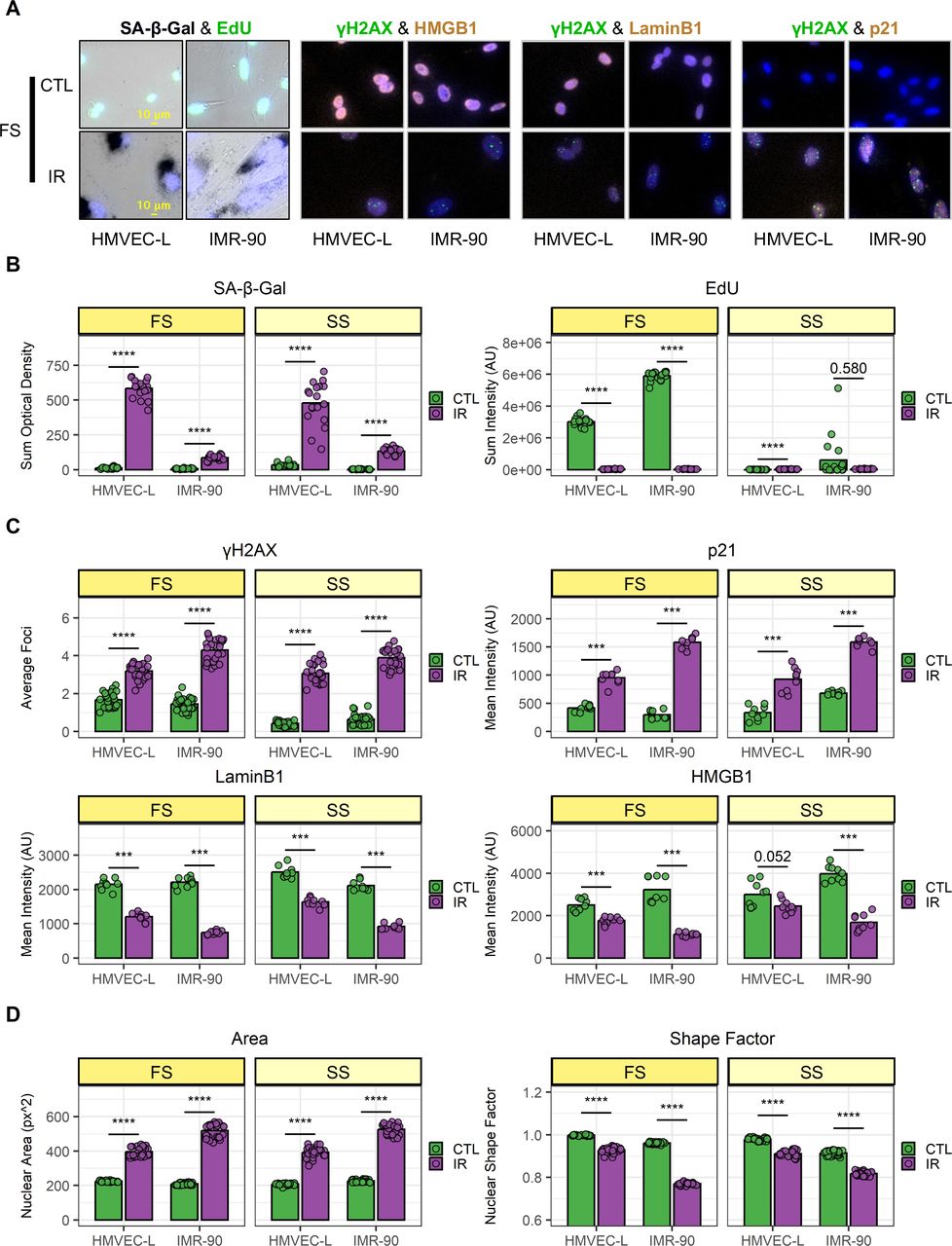
    Validation of senescence induction and population-level heterogeneity . a ) Representative images of senescence marker staining from full-serum (FS) samples. Top: mock-irradiated cells (CTL); bottom: ionizing-radiation-induced senescent cells (IR). For each co-staining, endothelial cells (HMVEC-L) are shown on the left; fibroblasts (IMR-90) are shown on the right. b-d ) Image quantification of HMVEC-L and IMR-90 cells for both FS and serum- starved (SS) conditions. CTL samples are in green, while IR samples are in purple. Data shown are from 2 independent experiments. b ) SA-β-Gal (left) and EdU (right) staining quantification. Each data point corresponds to one well (n = 18); bars indicate mean values. c ) Immunocytochemistry staining quantification. Top-left: γH2AX; top-right: p21; bottom-left: LaminB1; bottom-right: HMGB1. Each data point corresponds to one well (γH2AX n = 27; p21, LaminB1, and HMGB1 n = 9); bars indicate mean values. d ) Nuclear morphology feature quantification. Left: nuclear area; right: shape factor. Each data point corresponds to one well (n = 27); bars indicate mean values. ***: p-value < 10 -3 ; ****: p-value < 10 -4 ; non-significant values (p-value > 0.05) are shown.

    Journal: bioRxiv

    Article Title: Senescent cell heterogeneity and responses to senolytic treatment are related to cell cycle status during cell growth arrest

    doi: 10.1101/2024.06.22.600200

    Figure Lengend Snippet: Validation of senescence induction and population-level heterogeneity . a ) Representative images of senescence marker staining from full-serum (FS) samples. Top: mock-irradiated cells (CTL); bottom: ionizing-radiation-induced senescent cells (IR). For each co-staining, endothelial cells (HMVEC-L) are shown on the left; fibroblasts (IMR-90) are shown on the right. b-d ) Image quantification of HMVEC-L and IMR-90 cells for both FS and serum- starved (SS) conditions. CTL samples are in green, while IR samples are in purple. Data shown are from 2 independent experiments. b ) SA-β-Gal (left) and EdU (right) staining quantification. Each data point corresponds to one well (n = 18); bars indicate mean values. c ) Immunocytochemistry staining quantification. Top-left: γH2AX; top-right: p21; bottom-left: LaminB1; bottom-right: HMGB1. Each data point corresponds to one well (γH2AX n = 27; p21, LaminB1, and HMGB1 n = 9); bars indicate mean values. d ) Nuclear morphology feature quantification. Left: nuclear area; right: shape factor. Each data point corresponds to one well (n = 27); bars indicate mean values. ***: p-value < 10 -3 ; ****: p-value < 10 -4 ; non-significant values (p-value > 0.05) are shown.

    Article Snippet: Primary human lung microvascular endothelial cells (HMVEC-L) were purchased from Lonza (CC-2527).

    Techniques: Marker, Staining, Irradiation, Immunocytochemistry

    Effect of IL-6 trans-signalling on human endothelial cells and lung fibroblasts. Human lung microvascular endothelial cells (HLMVEC), human umbilical vein endothelial cells (HUVEC) and human lung fibroblast (IMR-90) were treated with vehicle (control), IL-6 (20 ng/mL), IL-6R (20 ng/mL) or IL-6:sIL-6R (Complex, 20 ng/mL) in the presence or absence of sgp130Fc (300 ng/mL). a) Representative Western blot of P (Tyr705)-STAT3, STAT3, P (Tr1034/1035)-JAK1 and JAK1 from cell lysates after 15 min and 24 h of treatment. b) mRNA expression of proinflammatory markers ( Ccl2 , Cxcl2 and Icam1 ) by qPCR after 24 h of treatment. c) TEER assays performed in HLMVEC stimulated with vehicle (control) and IL-6:sIL-6R complex in the presence or absence of sgp130Fc. TEER was continuously measured for 40 h, and rabbit (Rb) was modelled with the ECIS software. d) Representative Western blots, Il6st (gp130) mRNA expression by qPCR and gp130 protein levels in supernatants from cultured cells after 24 h of treatment. e) Il6 mRNA expression by qPCR and IL-6 levels by ELISA in supernatants from cultured cells after 24 h of treatment. Data are combined from 4–3 independent experiments. Control is set to 1 for each experiment and data presented as fold-change vs control. Complex: IL-6:sIL-6R. Complex + sgp130Fc: IL-6:sIL-6R:sgp130Fc. All graphs show mean and 95% CI. Statistics were calculated by Kruskal Wallis test with Mann–Whitney U-test. p values vs vehicle-treated control (above) and vs complex (bar) are indicated in the graphs.

    Journal: eBioMedicine

    Article Title: Targeting IL-6 trans-signalling by sgp130Fc attenuates severity in SARS-CoV-2 -infected mice and reduces endotheliopathy

    doi: 10.1016/j.ebiom.2024.105132

    Figure Lengend Snippet: Effect of IL-6 trans-signalling on human endothelial cells and lung fibroblasts. Human lung microvascular endothelial cells (HLMVEC), human umbilical vein endothelial cells (HUVEC) and human lung fibroblast (IMR-90) were treated with vehicle (control), IL-6 (20 ng/mL), IL-6R (20 ng/mL) or IL-6:sIL-6R (Complex, 20 ng/mL) in the presence or absence of sgp130Fc (300 ng/mL). a) Representative Western blot of P (Tyr705)-STAT3, STAT3, P (Tr1034/1035)-JAK1 and JAK1 from cell lysates after 15 min and 24 h of treatment. b) mRNA expression of proinflammatory markers ( Ccl2 , Cxcl2 and Icam1 ) by qPCR after 24 h of treatment. c) TEER assays performed in HLMVEC stimulated with vehicle (control) and IL-6:sIL-6R complex in the presence or absence of sgp130Fc. TEER was continuously measured for 40 h, and rabbit (Rb) was modelled with the ECIS software. d) Representative Western blots, Il6st (gp130) mRNA expression by qPCR and gp130 protein levels in supernatants from cultured cells after 24 h of treatment. e) Il6 mRNA expression by qPCR and IL-6 levels by ELISA in supernatants from cultured cells after 24 h of treatment. Data are combined from 4–3 independent experiments. Control is set to 1 for each experiment and data presented as fold-change vs control. Complex: IL-6:sIL-6R. Complex + sgp130Fc: IL-6:sIL-6R:sgp130Fc. All graphs show mean and 95% CI. Statistics were calculated by Kruskal Wallis test with Mann–Whitney U-test. p values vs vehicle-treated control (above) and vs complex (bar) are indicated in the graphs.

    Article Snippet: Human primary lung microvascular endothelial cells (HMVEC-L-Lung MV Endo, EGM-2MV, CC-2527, Lonza, Basel, Switzerland) were cultured using CC-3202 EGM-2 MV BulletKit (CC-3156_CC-4147, Lonza).

    Techniques: Control, Western Blot, Expressing, Software, Cell Culture, Enzyme-linked Immunosorbent Assay, MANN-WHITNEY

    Graphical abstract: IL-6 trans-signalling in SARS-CoV-2 infection on lung microvascular endothelial cells and therapeutic inhibition of IL-6 trans-signalling. Increased levels of IL-6:sIL-6R complexes observed in SARS-CoV2-infected mice induce endothelial cell dysfunction, widespread endothelial damage, coagulopathy and vascular leakage. Therapeutic IL-6 trans-signalling blockade by sgp130Fc exerts anti-inflammatory and anti-coagulant properties and recovers vascular integrity.

    Journal: eBioMedicine

    Article Title: Targeting IL-6 trans-signalling by sgp130Fc attenuates severity in SARS-CoV-2 -infected mice and reduces endotheliopathy

    doi: 10.1016/j.ebiom.2024.105132

    Figure Lengend Snippet: Graphical abstract: IL-6 trans-signalling in SARS-CoV-2 infection on lung microvascular endothelial cells and therapeutic inhibition of IL-6 trans-signalling. Increased levels of IL-6:sIL-6R complexes observed in SARS-CoV2-infected mice induce endothelial cell dysfunction, widespread endothelial damage, coagulopathy and vascular leakage. Therapeutic IL-6 trans-signalling blockade by sgp130Fc exerts anti-inflammatory and anti-coagulant properties and recovers vascular integrity.

    Article Snippet: Human primary lung microvascular endothelial cells (HMVEC-L-Lung MV Endo, EGM-2MV, CC-2527, Lonza, Basel, Switzerland) were cultured using CC-3202 EGM-2 MV BulletKit (CC-3156_CC-4147, Lonza).

    Techniques: Infection, Inhibition
